

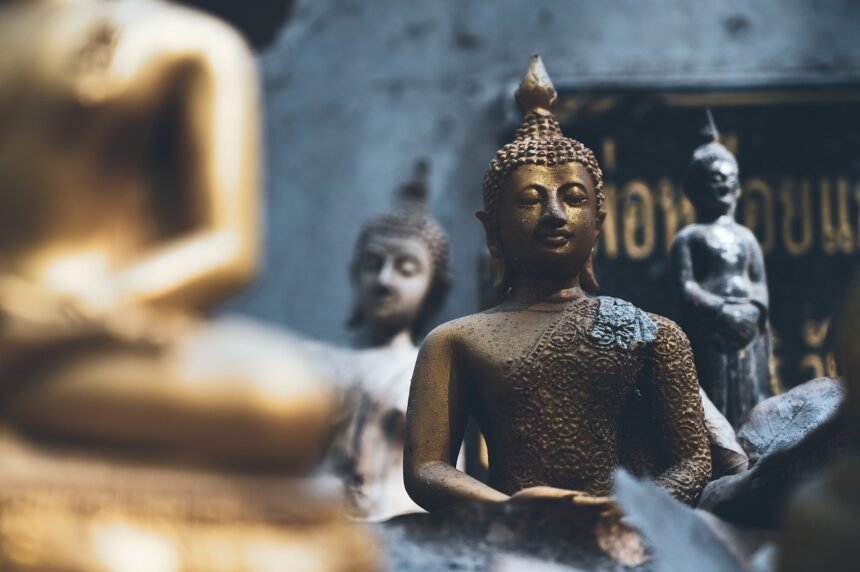
To help you visualize and choose the perfect Buddha painting, here are some inspiring styles and ideas widely admired by collectors and interior designers:
- Golden Thai Buddha Paintings
- Typically feature gold leaf highlights on the Buddha’s robes, halo, or background.
- Ideal for creating a focal point in living rooms or meditation spaces.
- Combines elegance with spiritual energy, making it perfect for luxury interiors.
- Typically feature gold leaf highlights on the Buddha’s robes, halo, or background.
- Tibetan Thangka-Inspired Art
- Richly detailed, featuring mandalas, Bodhisattvas, and protective deities.
- Can be hung on walls or used in a meditation altar.
- Traditional thangkas are spiritual teaching tools as well as decorative pieces.
- Richly detailed, featuring mandalas, Bodhisattvas, and protective deities.
- Minimalist and Monochrome Buddha Paintings
- Simple lines and muted tones emphasize calm and serenity.
- Works well in modern apartments, yoga studios, or home offices.
- Often features the Dhyana Mudra or seated Buddha in meditation posture.
- Simple lines and muted tones emphasize calm and serenity.
- Nature-Themed Buddha Paintings
- Integrates lotus flowers, bodhi trees, waterfalls, or clouds.
- Connects the Buddha’s tranquility with the natural world.
- Adds a refreshing, calming aesthetic to indoor spaces.
- Integrates lotus flowers, bodhi trees, waterfalls, or clouds.
- Abstract and Contemporary Interpretations
- Uses bold brushstrokes, textures, and geometric forms.
- Evokes peace and mindfulness without strict adherence to iconography.
- Appeals to younger audiences and art collectors seeking modern spirituality.
- Uses bold brushstrokes, textures, and geometric forms.
- Reclining Buddha Paintings
- Symbolizes Parinirvana and ultimate peace.
- Perfect for meditation corners or serene bedrooms.
- Often depicted with calm, muted backgrounds and gentle color gradients.
- Symbolizes Parinirvana and ultimate peace.
- Digital and Mixed-Media Buddha Art
- Combines traditional imagery with modern printing techniques, 3D textures, or metallic accents.
- Suitable for contemporary interiors and art-forward meditation spaces.
- Combines traditional imagery with modern printing techniques, 3D textures, or metallic accents.
Integrating Buddha Paintings into Your Daily Practice
A Buddha painting can do more than decorate—it can actively enhance mindfulness and meditation:
- Meditation Focus
- Place the painting in your meditation space. Focus on the mudra or expression of the Buddha to anchor your attention.
- Helps cultivate mindfulness, compassion, and inner calm.
- Place the painting in your meditation space. Focus on the mudra or expression of the Buddha to anchor your attention.
- Energy and Feng Shui
- In Feng Shui, a Buddha painting placed in the east or southeast corner of your home promotes harmony and abundance.
- Avoid placing it in bedrooms, bathrooms, or below eye level, as respectful placement enhances positive energy.
- In Feng Shui, a Buddha painting placed in the east or southeast corner of your home promotes harmony and abundance.
- Daily Inspiration
- Viewing the painting during daily routines—like morning coffee or evening relaxation—can encourage mindfulness.
- Choose paintings that evoke calm, positivity, and spiritual reflection.
- Viewing the painting during daily routines—like morning coffee or evening relaxation—can encourage mindfulness.
- Creating a Sacred Corner
- Pair the Buddha painting with candles, incense, or small altars.
- Use soft lighting to enhance its meditative presence and visual impact.
- Pair the Buddha painting with candles, incense, or small altars.
FAQs About Buddha Paintings
Q1: Can I use a Buddha painting as home decor without being Buddhist?
- Yes. The image of the Buddha represents peace, mindfulness, and spiritual wisdom. Respectful use in decor is acceptable, regardless of religious affiliation.
Q2: How do I choose the right mudra for my painting?
- It depends on your intention. Meditation (Dhyana Mudra) for focus, teaching (Vitarka Mudra) for learning spaces, and compassion (Varada Mudra) for living areas or workspaces.
Q3: Are digital prints as valuable as traditional paintings?
- Digital prints are visually appealing and often more affordable. Traditional paintings or Thangkas carry higher spiritual and artistic value but may require careful preservation.
Q4: How should I clean or maintain a Buddha painting?
- Dust regularly with a soft cloth. Avoid direct sunlight, excessive moisture, or abrasive cleaning agents. Frame and cover delicate artworks if needed.
Q5: Can Buddha paintings be gifted?
- Yes, they make meaningful gifts for anyone interested in mindfulness, meditation, or spiritual art. Ensure the recipient values the symbolism and place it respectfully in their space.
Conclusion: Inviting Peace and Wisdom into Your Life
A Buddha painting transcends decoration. It is a visual meditation, a spiritual guide, and a connection to centuries of cultural heritage. Whether you choose a traditional Thai gold-leaf painting, a minimalist ink wash, or a vibrant Thangka, your painting can inspire calm, mindfulness, and reflection daily. By selecting thoughtfully, respecting the symbolism, and placing it with intention, you bring more than art into your space—you bring a sanctuary of peace and wisdom.
The right Buddha painting becomes a companion on your personal journey toward balance and serenity, offering a constant reminder of the values of compassion, mindfulness, and inner stillness.